.png)
Does Getting Your Medications Delivered Actually Help You Take Them? The Research Says Yes.
Does Getting Your Medications Delivered Actually Help You Take Them? The Research Says Yes.
Medication adherence — taking your prescriptions on time, at the right dose, without skipping or stopping — is one of the most important factors in whether a treatment actually works. And yet, for the roughly 50% of patients who don't consistently take their medications as prescribed, the consequences can be serious.
What most patients don't realize is that how you get your medications has a measurable impact on whether you take them. A substantial body of peer-reviewed research shows that patients who use delivery pharmacy services are consistently more adherent than those who pick up medications at a retail pharmacy.
Here's what the science says — and why it matters.
The Scale of the Non-Adherence Problem
Before looking at the delivery-adherence connection, it's worth understanding how significant the adherence problem actually is.
Medication non-adherence in the United States is associated with approximately 125,000 deaths annually and at least 10% of hospitalizations. The direct cost to the healthcare system is estimated at $100 billion to $300 billion per year in avoidable spending — hospitalizations, emergency room visits, and the treatment of complications that proper medication use could have prevented.
More than one in five new prescriptions go unfilled entirely. And among patients who do fill an initial prescription, 50% discontinue their medication within the first year.
For patients managing chronic conditions — high blood pressure, diabetes, high cholesterol, heart disease — the stakes of skipping doses are not abstract. Poor adherence to blood pressure medication is associated with uncontrolled hypertension. Poor adherence to diabetes medication worsens glycemic control and raises the risk of complications including retinopathy, nephropathy, and hospitalization. The research consistently links non-adherence to disease progression, more frequent hospitalizations, and higher mortality risk.
Why People Don't Take Their Medications
The reasons for non-adherence are varied, but several patterns appear consistently in the research:
Inconvenience. Patients who run out of medication and can't get to a pharmacy — due to work schedules, transportation challenges, or simply forgetting — skip doses or go without until the next refill pickup is possible.
Cost. When medication feels unaffordable, patients ration — taking half doses, skipping days, or abandoning a prescription altogether. Prescription abandonment rates are below 5% when the out-of-pocket cost is zero, but rise to 45% when the cost exceeds $125.
Forgetfulness. Without a system to prompt refills, patients often realize they've run out only when it's too late to avoid a gap in therapy.
Pharmacy access barriers. For seniors, patients with mobility limitations, or those without reliable transportation, a trip to the pharmacy isn't always straightforward.
Delivery pharmacy directly addresses most of these barriers.
What the Research Shows: Delivery Pharmacy and Adherence
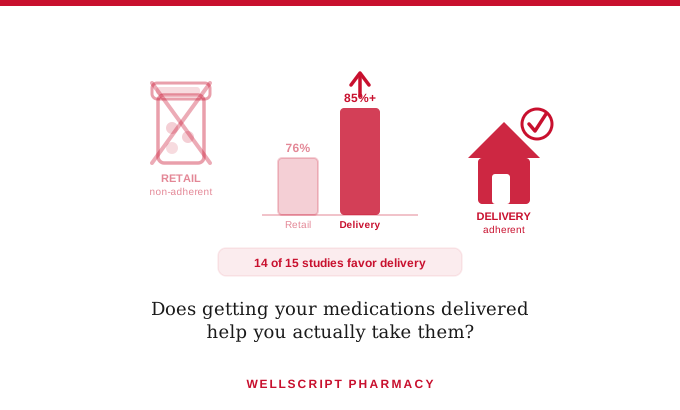
A landmark review published in the Journal of Managed Care & Specialty Pharmacy examined 15 peer-reviewed studies comparing medication adherence between mail-order/delivery pharmacy and retail pharmacy patients. The finding was striking: 14 out of 15 studies found higher adherence among delivery pharmacy patients. The one remaining study found equal adherence between the two groups. Not a single study found retail pharmacy patients to be more adherent.
The adherence differences across studies were meaningful in magnitude. The lowest difference observed was 7 percentage points among patients taking hypertension medications. The highest was 22.7 percentage points among asthma patients.
A separate study published in the American Journal of Managed Care examined adherence to three of the most commonly prescribed drug classes — antidiabetics, antihypertensives, and antihyperlipidemics — across a large national pharmacy claims database. After controlling for prior adherence behavior, days of supply, demographics, and disease burden, patients using delivery pharmacy had significantly better adherence in all three drug classes compared to retail pharmacy patients.
The researchers concluded that delivery pharmacy's adherence advantage was not simply an artifact of patients receiving a larger supply at once — it was a genuine effect of the delivery channel itself.
The Diabetes Data Is Especially Compelling
For patients managing type 2 diabetes, the adherence research on delivery pharmacy is particularly robust.
A retrospective study of Medicare Advantage patients with type 2 diabetes, published in the Journal of Managed Care & Specialty Pharmacy, tracked adherence to oral antihyperglycemic agents over multiple years. Mail-order pharmacy users consistently showed greater adherence than community pharmacy users — and the advantage held up across 12, 24, 36, and 48 months of follow-up.
Crucially, the study also examined clinical outcomes. Patients using delivery pharmacy had better glycemic control at 12 months (91% vs. 89% achieving target control) and across subsequent years. Better glycemic control means fewer complications — and for diabetic patients, that translates directly to reduced risk of hospitalization, kidney damage, and vision loss.
For patients managing diabetes, adherence isn't just a convenience metric. It is a direct driver of long-term health.
Why Delivery Pharmacy Improves Adherence
The research points to several mechanisms:
Medications arrive before you run out. Rather than realizing you're out of medication and having to make an urgent pharmacy trip, delivery pharmacy patients receive refills proactively — closing the gap between running out and reordering that causes many lapses in adherence.
Refill friction is eliminated. The inconvenience of getting to a pharmacy — especially for seniors, caregivers, or anyone with a busy schedule — is a real barrier for many patients. When that friction disappears, so does one of the most common reasons for skipping a refill.
A single pharmacist manages your full medication profile. When all of your prescriptions run through one pharmacy, your pharmacist can identify when a refill is coming due, flag potential gaps, and follow up proactively. This kind of coordinated oversight doesn't happen when prescriptions are spread across multiple retail locations.
Synchronized refill schedules. Wellscript Pharmacy works to align your refill dates so that your medications arrive together on a regular schedule, rather than staggered across the month. This predictability makes it easier to build medication-taking into a consistent daily routine.
What This Means for Wellscript Pharmacy Patients
At Wellscript Pharmacy, medication adherence isn't a side benefit of delivery — it's one of the core reasons delivery pharmacy exists.
When your medications arrive at your door on schedule, coordinated by a licensed pharmacist who knows your complete prescription history, you don't have to manage the logistics of refills around your own schedule. You don't miss doses because you ran out on a weekend. You don't skip a refill because the pharmacy line was too long or the drive wasn't worth it that day.
The research is consistent and clear: patients who use delivery pharmacy take their medications more reliably. And patients who take their medications more reliably have better clinical outcomes — fewer hospitalizations, better disease control, and lower long-term healthcare costs.
Free delivery. Synchronized refills. A pharmacist who manages the full picture. That's what Wellscript Pharmacy delivers — and the health outcomes research backs it up.
Call Wellscript Pharmacy at (248) 792-7059 to transfer your prescriptions. We deliver free to 50+ zip codes across metro Detroit, including Bloomfield Hills, Troy, Royal Oak, Birmingham, Farmington Hills, West Bloomfield, and surrounding communities.
Wellscript Pharmacy is a licensed Michigan delivery pharmacy located at 36400 Woodward Ave, STE 60, Bloomfield Township, MI. Adherence data sourced from peer-reviewed literature including Fernandez et al. (Journal of Managed Care & Specialty Pharmacy, 2016), AJMC (2013), and Journal of Managed Care & Specialty Pharmacy (2019). Non-adherence cost and mortality data sourced from Duke Health and published healthcare economics literature.